
Young Artists Without Borders: From Lebanon to London
CULTURE
10/23/20254 min read
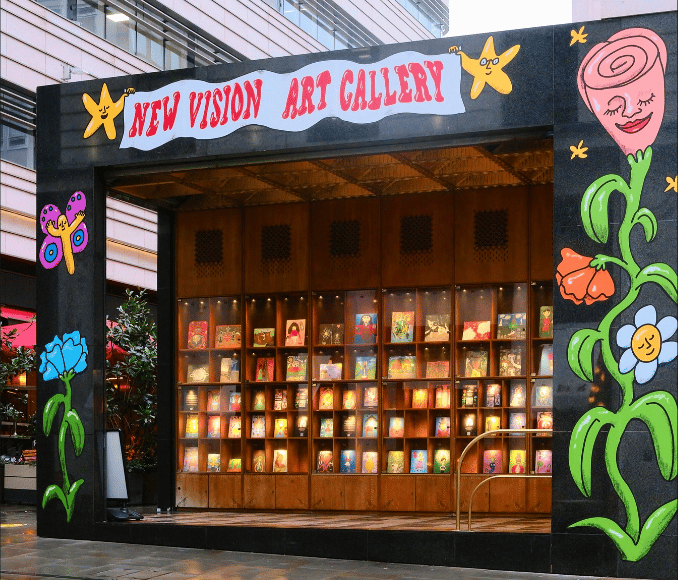
In the heart of London, St James pavilion, a small exhibition with a big heart is reframing how we think about art, aid, and agency. The show, the second public exhibition by New Vision Art Gallery, brings together works from two unlikely yet deeply connected communities: children from New Vision Art School in Haiti and students from AlSama in Lebanon, a pioneering education initiative transforming the lives of young refugees. ‘Our goal’, says Hani Asfari, the organiser behind the exhibition, ‘is to be a global gallery representing children in conflict zones from everywhere’.
A Gallery with a Mission
New Vision Art Gallery describes itself as a platform that merges innovative financial technology with art education to empower children living in conflict zones. The models is both transparent and radical in its simplicity. Ninety percent of proceeds from each artwork go directly to the child’s school, with the majority reaching the student/artist. The remaining share is used to provide materials and sustain their local art education programmes. It is a structure designed to prioritise dignity and economic empowerment over charity, ensuring that every sale builds both a livelihood and a creative future.
The gallery takes its name from New Vision Art School in Port-au-Prince, Haiti, a non-profit founded in 2016 by artist and educator Lesly Pierre Paul. The school offers free art classes and materials to children who otherwise would have no access to creative education. When Hani first encountered the school, he was struck by the art but also by the logistical obstacles that made it nearly impossible to support it. ‘You had to PayPal someone in the U.S. and they would Western Union the teacher’, he recalls... ‘It was really difficult. And I always said to the teacher, 'If I can help in some way set up a proper website in the future, I will.’
Hani made sure that that promise became a reality. With help from friends in banking and finance, he built a platform that connects buyers directly with young artists. Since its launch in October 2024, New Vision has sold more than $6,000 worth of artwork, most of it created by Haitian students with an average age of fourteen.
https://www.instagram.com/p/DQJqxb5jHIS/?utm_source=ig_web_copy_link
From Shatila to the World
Now, the gallery’s reach extends to Lebanon through a partnership with AlSama, meaning ‘sky’ in Arabic. Founded in 2020 in Beirut’s Shatila refugee camp, AlSama began as a youth empowerment centre for forty teenagers who were determined to escape child marriage and forced labour. Within just a few years, it has grown into four education centres serving nearly 900 students. Ninety percent of AlSama’s pupils arrive illiterate, yet within six months, every single one can read and write.
Their programme is holistic, teaching Arabic, English, Mathematics, art, and competitive sports, while fostering self-confidence and community leadership. The organisation’s vision is to redefine refugee education so that young refugees can co-create a more peaceful world. In this exhibition, their student’s art stands beside that of Haitian children, two bounds by a shared artistic expression, despite adversity.
The Economics of Empowerment
For Hani, the exhibition's success lies in its emotional and cultural expression, but also importantly, in material impact. ‘It sounds very cold.’ he admits, ‘but for me, it’s the paintings I’m able to sell. That’s money that goes directly to the families and the children.’ One young artist in Haiti, he recounts proudly, earned £400 in a single month, becoming a main earner in his household. ‘We were so proud of that,’ he says.
But economic empowerment is only part of the story. Engaging with art has loads of benefits for anyone, especially for kids.’ Hani says. ‘It’s a wonderful way for them to empower themselves economically, but also emotionally.’ He avoids the label of ‘art therapy,’ preferring to think of creation as a form of agency, a way for children to see their own ideas and experiences take tangible forms.
Creating conversation
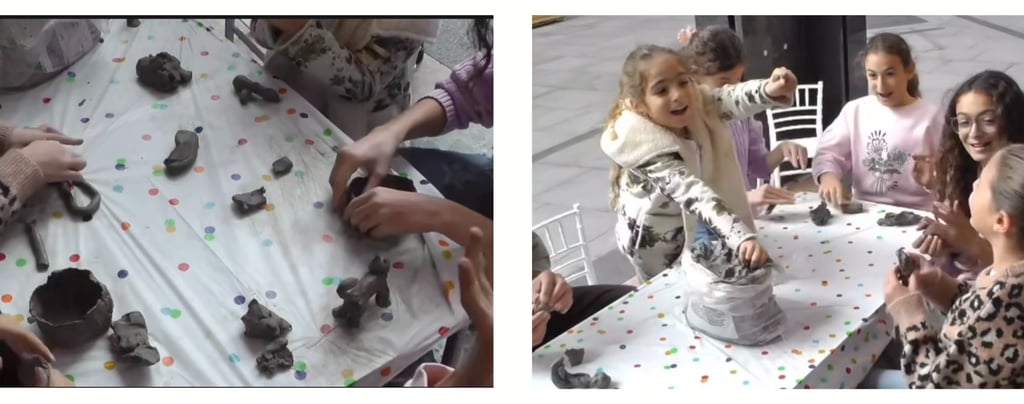
One of the most striking aspects of this outdoor exhibition is its accessibility. When I visited the free clay workshop, one of a series of free activities and workshops organised in tandem with the exhibition, was almost as central to the experience as the displayed paintings themselves. It invited the children of the British public to enter into this conversations between the children of Haiti and Lebanon, and this participatory energy reflected perfectly the exhibition’s ethos: that art should be both a shelter and a bridge between worlds.
‘Part of this project,’ Hani explained, ‘is it’s an amazing way for the diaspora communities to connect with local people and empower kids through art and money.’ For visitors without personal ties to these regions, it becomes a way to ‘experience local cultures, without necessarily leaving your house.’
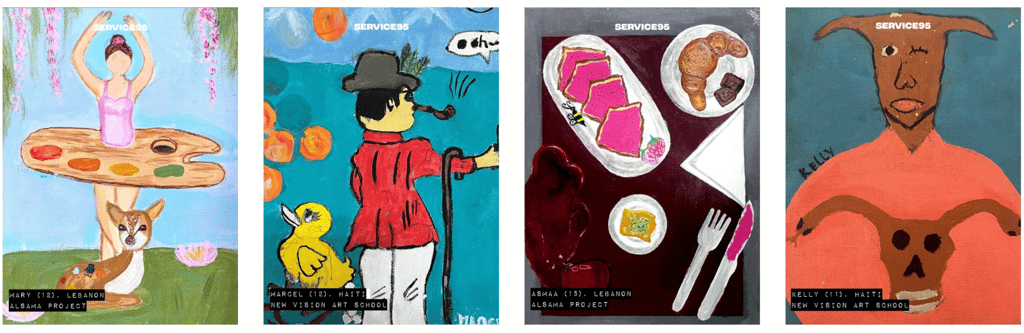
The artworks, selected by the children’s teachers remain raw and uncurated. ‘I’m not going to tell an 11-year-old, “sorry that doesn’t cut it,”’ Hani laughs. The result is a mosaic of sincerity and imagination: bright landscapes, portraits of home, of Al Aqsa, of a dinner table, and fragments of memory and family.
New Vision’s ambitions continue to grow. ‘Our plan is to become a global gallery,’ Hani says. ‘Whether it’s Congo, Sudan, the Middle East…I want to make sure that I’m working with and around Palestinian children for now.’ The gallery’s success, measured in both art sales and partnerships, signals a new model for creative philanthropy: one that replaces charity with collaboration.
https://www.instagram.com/reel/DPvem9nCETZ/?igsh=MTk3dDFsYnowbXZpZQ==
As I sat at the workshop that day, I watched as clay figurines were moulded in the hands of the children around me, tiny, imperfect, and full of life. Fitting symbols for the project itself, fragile yet brave, shaped by many hands.
The children of Haiti and Lebanon may never meet, but their shared vision of possibility now travels far beyond their classrooms. In the heart of London, their brave expressions educate us too, reminding us that art is the ultimate language of humanity, a conversation and a tool for agency and shelter and that from the smallest gestures, whether a brushstroke or a handful of clay, a new horizon can emerge.

