
How Italy Helped Libya's Most Wanted Killer Escape Justice
POLITICS
Asma Issa
10/6/20256 min read


In the heart of Tripoli, a man in a white thobe pins his victim to the street and beats him to death. The killer is Osama Almasri Njeem, a warlord better known as Almasri, a name in Libya already synonymous with bloodshed. In late August, video of the daylight murder ricocheted across social media, sparking outrage. But for Almasri, this was no aberration. For years, he has been accused of heinous crimes, a record so grave that the International Criminal Court has issued a warrant for his arrest.


Video clip allegedly showing AlMasri assaulting a man in Tripoli (X)
Osama Njeem AlMasri
Almasri: The Glorified Warlord
And yet, in January 2025 Osama Njeem Almasri stepped off a plane in Mitiga airport to applause. Cameras captured the moment: AlMasri walking free, grinning without a care in the world. A state plane had carried him from Rome to Tripoli, escorted in luxury, not in handcuffs. The man accused of overseeing the heinous crimes hidden in Mitiga’s prison, torture, rape, and murder returned as a hero.
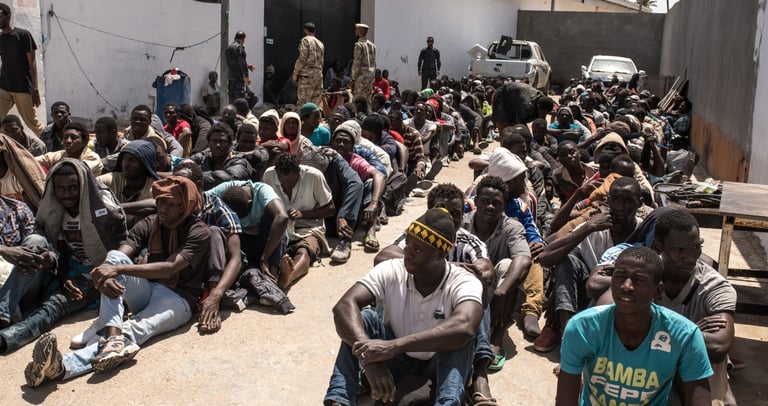
Days earlier, On January 19, there was hope as Italian police in Turin had rightfully arrested Almasri on a sealed warrant issued by the International Criminal court (ICC) for the gravest of charges: crimes against humanity and war crimes committed behind the bars of Mitiga prison, in cells filled with dissidents, migrants, children, their lives broken under systematic abuse.
AlMasri was no minor official; he was a long-time member of the powerful Deterrence Apparatus for Combating Terrorism and Organised Crime (DACTO) militia, one of the many militias which function as glorified gangs and between whom power within the Libyan capital is split constantly renegotiated through regular violent clashes. These power-hungry militias have been allowed to flourish, amassing vast wealth and consolidating military and political influence in the chaos left by Libya’s collapse. The power vacuum and prolonged instability that followed the 2011 revolution and NATO’s bombing campaign, compounded by years of sustained Western intervention and provocation through civil and proxy wars, created the perfect conditions for their rise.
Most notoriously, Almasri served as the director of the infamous Mitiga detention centre in Tripoli, a prison within Mitiga airport, the only functioning airport within the city and fully under the control of the DACTO forces. For years under Almasri’s watch, this facility, the largest in Western Libya, and for which human rights organisations across the world have been ringing alarm bells. Simply a five minute scroll through the X page of Refugees In Libya or David Yambio’s page, activists dedicated to documenting and protesting the hidden horrors faced by refugees in Libya, is enough to disturb, enough to enrage, and enough to understand why any step, taken by any one or any state, toward justice against men like Almasri has become an urgent moral duty.
Rome’s Betrayal of the Rome Statute:
When Italian police successfully detained AlMasri in Turin on January 19 2025, it was hailed as a momentary victory for justice. But merely fleeting, because within two days, the Rome court of appeal ordered his immediate release. The Ministry of Justice, they said, had not signed off on the warrant before police acted. On such a technicality, Italy freed a man accused of some of the gravest crimes in modern Libya. Within hours, arrangements were made for his repatriation.
Italy’s subsequent actions are a clear systemic collapse of moral and legal duty. As a State Party to the Rome Statute , Italy is bound by Article 89 to arrest and surrender those wanted by the Court, and by Article 86 to cooperate fully. Italy’s failure to hold AlMasri was, unequivocally, a serious breach of its obligations. Survivors of that prison saw the man responsible for their suffering return with dignity and honor and they understood, clearly, what Italy had proven, that their suffering was negotiable, their tormentor untouchable, and to the west, international law is little more than an impotent facade.
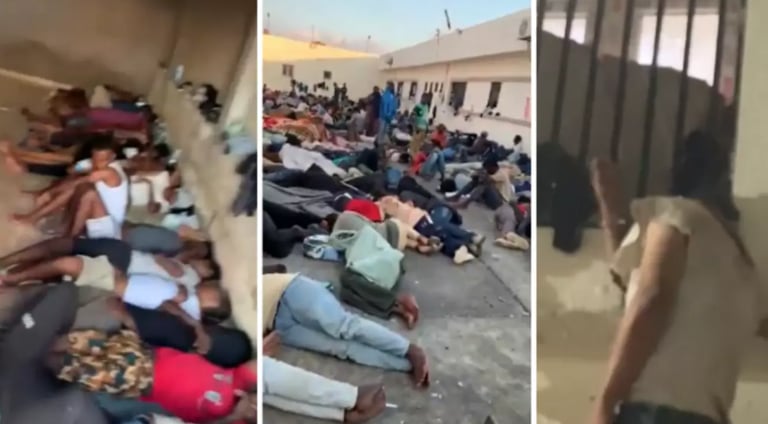
Screenshots from videos published in early September by Refugees in Libya showing the living conditions of refugees imprisoned in the detention centre in Tobruk, Libya. (X)
Human Rights Watch was unsparing, declaring: ‘Rome has betrayed the Rome Statute, again’ moving from ‘shameful words of non-cooperation with the ICC on Netanyahu’ to ‘deeds with AlMasri’s release’.
The MoU: Europe’s Dark Partnership with Libya
The betrayal cannot be understood without Italy’s deeper entanglement in Libya. The end of the colonial era did not sever Italy’s exploitative ties. Today, Rome depends on Libya not only for oil and gas, but also for outsourced border control. In 2017, Rome signed a Memorandum of Understanding (MoU) with Tripoli’s government, handing responsibility for migration management to militias and coast guards notorious for brutality.
AlMasri was precisely the kind of state-integrated militia commander necessary for the European project of outsourced border defence. The MoU, underwritten by the EU, funnels financial and technical support into the hands of profit-hungry Libyan militias. Ships, training, political legitimacy, and information acquired through aerial surveillance are all readily provided to militias. The EU’s border agency, Frontex, uses drones to patrol over the mediterranean and inform the so-called Libyan coastguard of the positions of refugee boats, which are then forced back to torture camps in Libya and into the hands of blood thirsty criminals, like Almasri. Between 2021 and 2024, Frontex shared boat coordinates of migrant boats with Libya’s authorities more than 2,000 times, according to Lighthouse Reports, a non-profit investigative-journalism group.
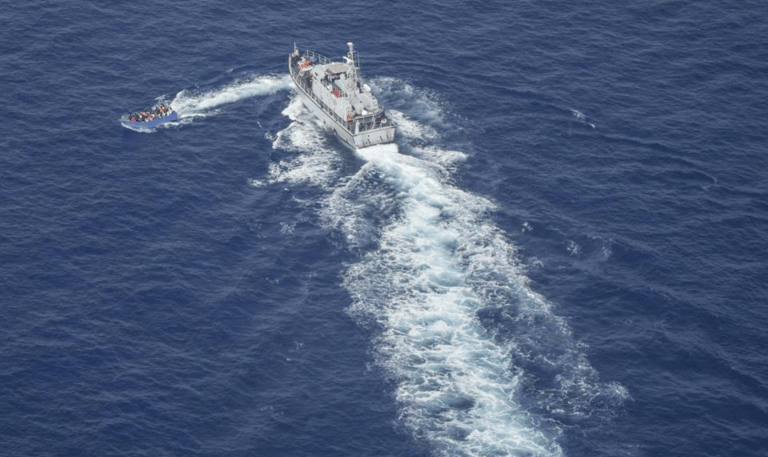
Footage showing Libyan militia vessel ramming and firing gunshots towards a migrant vessel. (Sea-Watch International).
On November 2 of this year, Italy is set to automatically renew its migration Memorandum with Libya until 2029, despite repeated warnings from UNHCR and the International Organization for Migration that Libya is not a ‘safe place.’ The renewal guarantees at least three more years of deaths, violations, and silence behind diplomatic rhetoric.
David Yambio writes on his X page that in the time since the Meloni administration has come into power and provided sustained support to Libyan militias and warlords ‘the result has been more death: more concentration camps, and more Italian taxpayers money funnelled to factions in Libya and Tunisia’. On another occasion, a video shared, shows an anonymous ‘Comrade J’, who lives in risk in Tripoli, pleading with the Italian Government and its Minister of Interior, Matteo Piantedosi, to ‘support the NGOs instead of funding militias. Support the humanitarian organisations and UNHCR to evacuate refugees who are stuck in Libya because of intensive support for militias.’ Instead, just three months before that Piantedosi had met with Saddam Haftar, head of one of East-Libya’s most ruthless militias, Tareq Bin Zayed (TBZ) accused of similar war crimes and abuses, to discuss mass migration and border security.
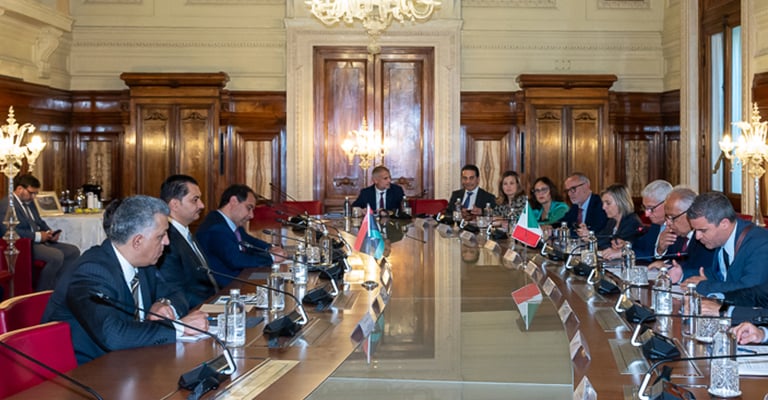
Matteo Piantedosi meets Saddam Haftar at Italian Interior Ministry 11 June 2025 (Ministero Dell’Interno)
Italy has not only consistently ignored protest groups, human rights organisations, and international lawyers who have warned of the detrimental consequences of enabling such breaches of international law, it has gone further, actively working to surveil and intimidate them. A report released in June of this year revealed that the Italian government had deployed Paragon’s Graphite spyware, a highly invasive surveillance tool developed by an Israeli firm, to monitor activists and journalists. Among those targeted were members of the Refugees in Libya organisation and its founder, David Yambio, as well as Luca Casarini and Dr. Giuseppe Caccia, co-founders of Mediterranea Saving Humans.
For Italy and the EU the prevention of asylum in Europe outweighs all else. By outsourcing violence to foreign shores, they hide the gruesome reality of their border policies, made even more vile by their protection of figures like Almasri. In shielding the perpetrators, they secure impunity for the very crimes they enable. Furthermore, the atrocities unfolding in Libya are instrumentalised in order to create a migration route, through Libya and beyond into the Mediterranean, which is as deadly of a route as possible. The construction and enabling of a racist machinery of torture serves not only as a means of control, but as a calculated, xenophobic deterrent to migration itself.
Italy and other EU nations remain complicit in grave crimes against humanity, taking advantage of a nation destabilised by western intervention and violent power vacuums for more than a decade. The MoU between Libya and Italy remains a signed agreement of mechanised violence from both nations and a reminder that Europe's migratory policy is antithetical to international law, justice, and humanity.

